
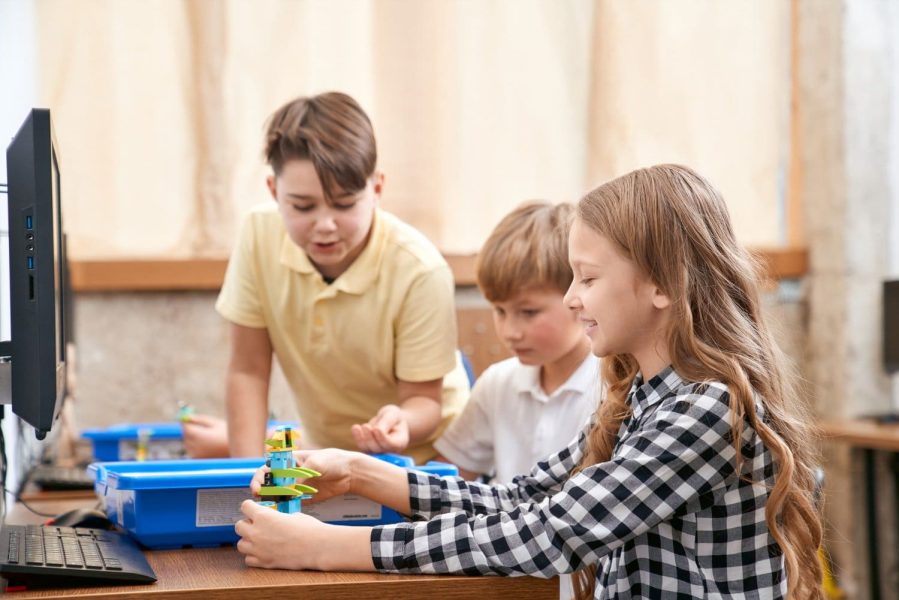
Have you ever seen a child completely invested in building a Lego castle or designing an entire Minecraft world? This imaginative play is where logic meets creativity, it is where trial and error lead to discovery. Now, if we take that same creative energy and transform it into a powerful, future-ready skill using 3D Modelling and computational thinking.
Here at PIEX Education, we believe children shouldn’t just learn about the future, they should build it. Easy accessibility of emerging AI-enhanced platforms like Cursor, DeepSeek, and Magnus have changed the way we learn. These tools are excellent in automating code and generating graphics and are designed to maximize human creativity.
Introduce children to our 3D Modelling Coding Courses for Kids, a space where design, technology, and problem-solving come together to prepare young minds for the future.

Why 3D Modelling Is a Game-Changer for Kids?
Actually, 3D modelling is more than just creating cool characters or digital spaces. It’s a learning tool that unlocks a new way of thinking. When a child sits down to model a shape, a robot, or an entire scene on a computer, they’re doing much more than “just design.” They’re building mental muscles that support lifelong learning:
- Learning how to visualise and build solutions from scratch
They start with a blank canvas and bring their ideas to life, step by step. This teaches patience, foresight, and the ability to refine ideas over time, essential qualities in any creative or technical field.
- Understanding how complex systems are made up of smaller parts
Whether it’s a digital building or a robotic arm, every project is built from individual components. Kids begin to see how systems work, how each part has a role, and how everything connects, a key principle in both engineering and real-world problem-solving.
- Applying logic, sequencing, and iteration
Also, 3D modelling often involves step-by-step planning and adjustments. Children learn to create, test, revise, and optimise—a cycle that strengthens their resilience and ability to approach challenges logically.
These skills align with computational thinking. They are a framework used across STEM disciplines to break down problems, recognise patterns, and design solutions using algorithms and abstraction. It’s not just about coding, it’s a way of thinking that prepares children to solve problems in any field, from science and medicine to art and entrepreneurship.
Moreover, AI-enhanced tools like DeepSeek and Magnus are more accessible and exciting than ever. These platforms help beginners improve their creative ideas by offering intelligent prompts, code suggestions, and real-time design feedback. So whether your child is building a 3D animal or designing a cityscape, these tools can boost their imagination, support their learning, and inspire them to aim higher.
What Is Computational Thinking—And Why Does It Matter?
Computational thinking might sound like something only programmers need to worry about, but it’s a life skill for the 21st century. At its core, computational thinking is the backbone of digital-age problem-solving. It’s how we break down challenges, identify the steps to solve them, and come up with logical, effective solutions. And yes, while it’s a must-have for future coders and engineers, its value goes far beyond the tech world.
Here’s how it helps children:
● Decomposition
Decomposition is about breaking down big problems into smaller, solvable chunks. This skill teaches kids that no problem is too big. Whether they’re trying to build a model city or complete a group project, they learn to break it into manageable tasks, one piece at a time.
● Pattern Recognition
Pattern recognition helps spot patterns and use them to predict outcomes. Learners begin to notice how certain actions lead to similar results. This helps them become more intuitive in their problem-solving, whether it’s predicting how a model will behave or solving a maths puzzle.
● Algorithms
As kids learn to play they create step-by-step solutions. They figure out what needs to happen first, second, and so on—just like writing a recipe or following instructions for building a Lego model.
● Logical Thinking
Children learn to think in abstract ways and test their ideas logically. This helps them step back and see the bigger picture. They learn how to spot what really matters, ignore distractions, and test out solutions to see what works best.
The best part is that it’s not just for coders. Whether your child wants to be a doctor, artist, architect, or even a video game designer, computational thinking trains them to approach problems creatively, logically, and with confidence.
Now, when you combine this mindset with 3D Modelling you get a hands-on, highly visual way to practice these skills. Instead of just learning about problem-solving, they do it by building models, making adjustments, testing ideas, and seeing the results come to life on screen. It’s learning by doing, and it sticks.
Where AI Meets Creativity and Learning
We’re entering a world where AI tools don’t replace creativity, they amplify it, that’s exactly what platforms like Cursor, DeepSeek, and Magnus are doing. These tools are not just smart gadgets, they’re co-pilots in the creative process, designed to help learners at every stage. Whether your child is new to coding or already exploring design software, these platforms provide a major boost in imagination and productivity.
Here’s how they support learning:
- Generate code snippets based on a student’s model or goal: If you’re stuck on how to animate a character or rotate a shape, these tools can provide instant suggestions that help move the project forward.
- Suggest design improvements or shortcuts: Instead of trial and error, learners get real-time advice—like adjusting scale, symmetry, or colour choices to improve their models with professional polish.
- Provide instant feedback and learning resources: Feedback is provided from video tips to interactive tutorials, students don’t have to wait for answers. They can learn, experiment, and grow all in one space.
- Support collaboration by helping students share and test each other’s models: Whether in the classroom or remotely, students can comment on each other’s designs, offer feedback, and build together. This builds on teamwork and peer learning which are key skills for the future.
At PIEX Education, we don’t just teach kids how to use these AI tools—we help them understand how they work, why they matter, and how to use them responsibly. That’s the essence of AI Literacy and Digital Fluency. These two essential skills are what every learner needs to thrive in tomorrow’s tech-driven world. Our goal is to help kids become creators, not just users of technology. To give them the tools to innovate, the confidence to explore, and the mindset to solve real-world challenges through creativity, logic, and ethical use of AI.
What Kids Learn in Our 3D Modelling Coding Course
Our 3D Modelling Coding Course for Kids is packed with hands-on learning and real-world fun. Here’s what they’ll dive into:
3D Design & Modelling Basics
Kids learn how to create objects, characters, and environments using beginner-friendly tools. They explore scale, symmetry, shapes, and perspective all while designing something uniquely their own.
Outcome: They’ll see their ideas take shape and come to life in 3D form, boosting both their confidence and creative thinking.
Computational Thinking Skills
Every project is an opportunity to practise breaking problems into parts, spotting patterns, and developing logical steps to achieve a goal.
Outcome: This isn’t just about coding, it’s about thinking like a problem solver, one step at a time.
Coding Meets Design
Learners explore basic code structures that support their 3D creations, such as animations, movements, and interactive features.
Outcome: They’ll discover that coding isn’t just technical, it’s creative, empowering them to control their digital world.
AI Tools in the Design Process
Given the access to tools like DeepSeek or Magnus, students can brainstorm ideas, troubleshoot designs, and even auto-generate basic code to speed up their work.
Outcome: It’s like having a friendly creative assistant right by their side, encouraging experimentation and big ideas.
Team Projects and Peer Feedback
Kids work together to build shared virtual worlds or solve design challenges. They share feedback, test different solutions, and refine their work.
Outcome: This helps build collaboration skills, empathy, and resilience—plus, it’s a whole lot of fun!
Real Skills, Real Confidence
Our course isn’t just about learning tools. It’s about helping kids:
- Build confidence in solving problems independently
- Feel proud of their ideas and creations
- Develop an early interest in STEM, design, and innovation
- Learn skills that align with future career pathways, from architecture and engineering to game development and animation
All while having fun, expressing themselves, and exploring what they’re capable of.
To Wrap Up: Why This Matters Now More Than Ever
In a world where nearly every industry is being transformed by AI, automation, and technology, we need young minds who are ready to think differently. Creativity and critical thinking are essential, not optional now.
When children build in 3D, they’re not just making cool objects. They’re:
- Learning how to solve real-world problems
- Preparing to work alongside AI tools, not be replaced by them
- Practising adaptability, design thinking, and digital fluency
At PIEX Education, we believe that the best way to prepare for the future is to create it—and we’re here to guide kids every step of the way. Check out our 3D Modelling Coding Course for Kids to see how your child can start building their future today—one block, code, and big idea at a time.
Feature Image Credit: Freepik